Exploring the World of Warehousing Technology
- Kyle O'Brien

- Sep 12, 2023
- 3 min read
Updated: Sep 14, 2023
In the ever-evolving landscape of supply chain management, warehouse automation technology has emerged as a game-changer. By harnessing the power of automation, warehouses can significantly improve throughput, profitability, accuracy, and scalability. In this blog post, we'll take a deep dive into the various types of warehouse automation technology that are shaping the future of warehousing.
Automated Guided Vehicles (AGVs)
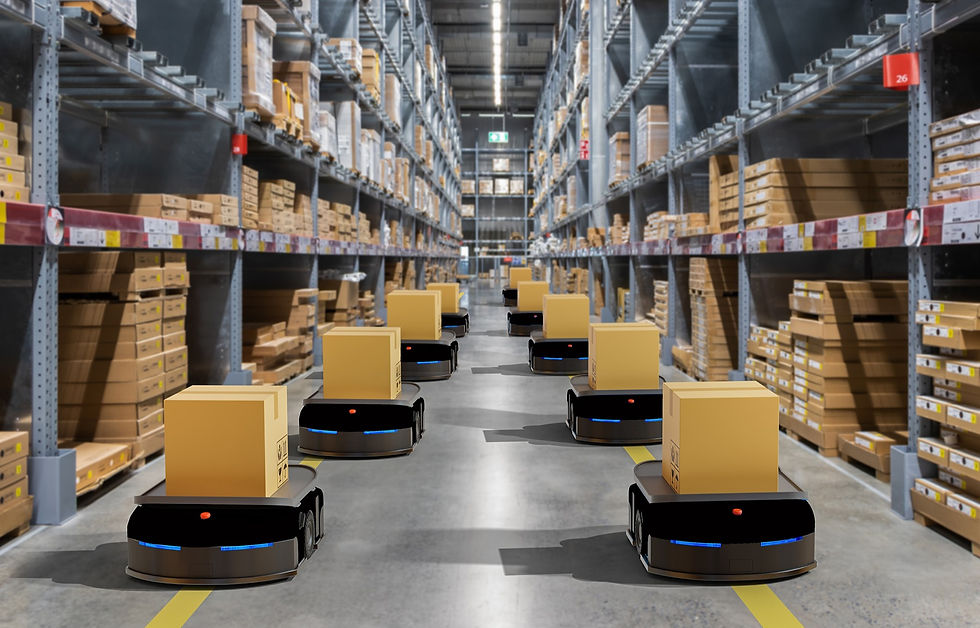
Automated Guided Vehicles, or AGVs, are autonomous vehicles designed to transport goods within a warehouse. These vehicles navigate through predefined paths using sensors, lasers, or magnetic strips, and they can be used in a variety of tasks including putaways, replenishments, picking, and sortation. AGVs are flexible and can be customized to suit different warehouse layouts and material handling requirements.
Autonomous Mobile Robots
Autonomous Mobile Robots, or AMRs, are similar to AVGs but offer more flexibility since they are not fixed to a path and instead use vision or laser guidance to detect people and obstacles. They can be easily programmed to find the best route to a destination and safely navigate even highly dynamic environments.

Automated Storage and Retrieval Systems (AS/RS)
AS/RS technology is designed to optimize horizontal and vertical storage space in warehouses. It consists of a system of shelves, racks, and robotic cranes that automatically store and retrieve items from their designated locations. AS/RS systems are known for their high-density storage capabilities, rapid retrieval times, and reduced need for manual labor.

Pick and Place Robots
Pick and place robots are robotic systems that specialize in selecting items from one location and accurately placing them in another. These robots are often equipped with advanced vision systems and grippers to handle a wide range of products. Some of these systems are even utilizing machine learning algorithms to accurately identify and grasp items. They excel in tasks like order picking and sorting, improving accuracy and speed in the process.

Conveyor Systems
Conveyor systems have been a staple of warehouse automation for years. They consist of a network of belts, rollers, or other mechanisms that transport goods within the warehouse. Conveyor systems are versatile and can be customized to accommodate various types of products, making them ideal for high-throughput operations.

Goods-to-Person (GTP) Systems
In GTP systems, products are brought directly to the worker, reducing the need for employees to traverse the warehouse to pick items. Automated systems transport shelving units or bins containing products to a workstation, where employees can pick the required items efficiently. GTP systems can greatly increase order picking speed and accuracy.

Voice and Pick-to-Light Systems
Voice and pick-to-light systems are designed to guide warehouse workers to their picking and packing tasks. Voice systems provide spoken instructions to workers through headsets, while pick-to-light systems use lights and displays to direct employees to the right items. These technologies reduce errors and increase productivity.

Automated Sortation Systems
Automated sortation technology uses a combination of conveyor belts, sensors, barcode scanners, and software to categorize and route items quickly and accurately. They can be used in the receiving, order fulfillment, and shipping operation. Some of these systems even ditch the more traditional linear conveyor and make use of small robots to sort items around a variable space.

Carton Erectors
Carton erectors have the ability to produce various box sizes on the fly, ensuring the perfect fit for each order, minimizing packaging costs. These machines take the hassle out of carton assembly, producing cartons at fast rates and with high precision.
Conclusion
Warehouse automation technology continues to evolve, revolutionizing the way businesses manage their supply chains and optimize their operations. The types of automation systems mentioned above are just a glimpse into the diverse range of technologies available to material handlers. As businesses strive to meet the growing demands of e-commerce and global distribution, investing in warehouse automation has become not only a competitive advantage but also a necessity for success in the agile world of logistics. By leveraging these technologies, companies can enhance efficiency, reduce labor costs, improve accuracy, and provide better service to their customers.

Comments